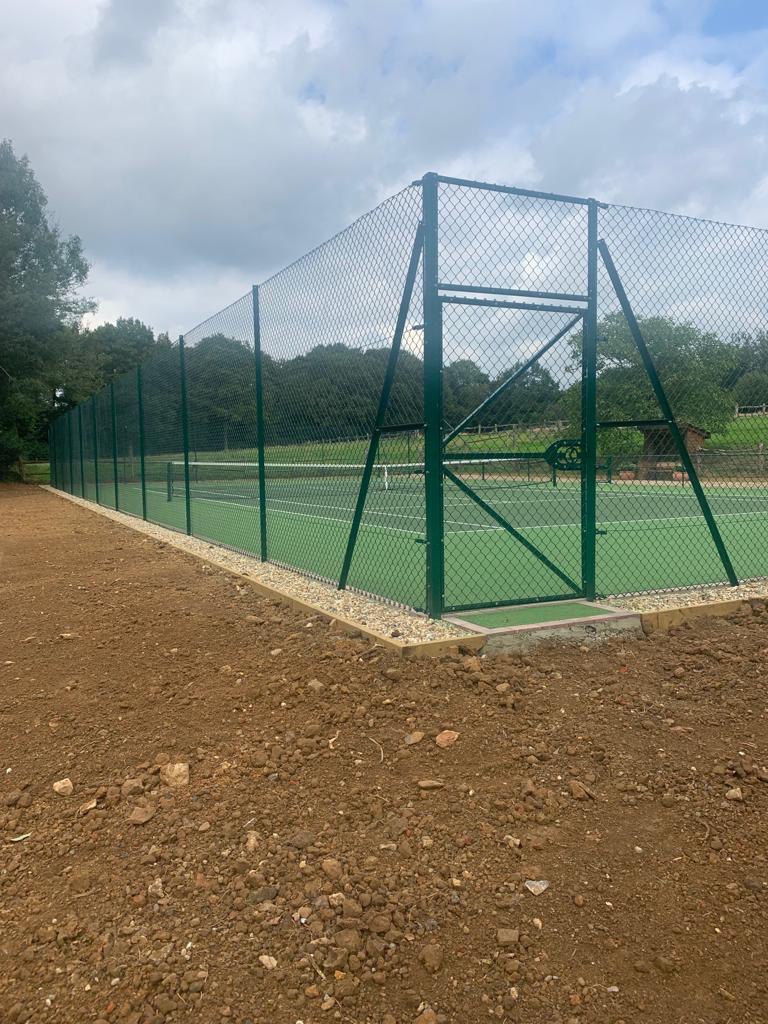
An ageing tennis court does not necessarily need to be abandoned or completely rebuilt. Many older courts can be significantly improved when the underlying construction remains suitable and the deterioration is addressed correctly. Cracking, fading, worn line markings, poor drainage and surface contamination can all affect how a court looks and plays, but the right refurbishment work can restore both performance and presentation.
At Tennis Court Construction Surrey, we provide professional tennis court construction, resurfacing and refurbishment services throughout Surrey, UK. The key to successfully restoring an older court is determining why its condition has declined before deciding which work will deliver the best long-term result.
What Happens to a Tennis Court as It Ages?
Outdoor tennis courts are continually exposed to changing weather conditions and regular use. Over time, these factors can gradually affect the playing surface and the construction beneath it.
Common signs of deterioration include:
- Cracks across the playing surface
- Faded or worn coatings
- Poorly defined line markings
- Uneven areas
- Moss and surface contamination
- Standing water after rainfall
- Reduced grip
- Loose or deteriorating surface material
Some of these problems are largely confined to the surface, while others may indicate deterioration deeper within the court construction.
The First Step Is Assessing the Existing Court
Before resurfacing an old tennis court, it is important to understand its overall condition.
Simply applying a new surface over unresolved structural problems can leave the underlying cause untouched. If movement, drainage defects or base deterioration are responsible for the damage, the same problems may eventually affect the renewed surface.
A professional assessment should consider the condition of the playing surface, base, drainage, surrounding edges and other relevant court features.
Surface Wear Can Often Be Addressed
A court may remain structurally sound while its upper surface becomes worn through years of use.
Signs can include fading, reduced texture and increasingly visible wear in frequently used playing areas.
Where the underlying construction remains stable, professional surface treatment or resurfacing can significantly improve the court’s playing characteristics and appearance without necessarily requiring complete reconstruction.
Cracking Needs to Be Investigated Carefully
Cracks are one of the most obvious signs of an ageing tennis court, but not all cracks have the same cause.
They can develop because of:
- Movement within the underlying construction
- Long-term weather exposure
- Deterioration of the existing surface
- Weaknesses within particular sections
- Water affecting the layers beneath
Repairing the visible crack alone may not provide a lasting solution if movement underneath continues.
Understanding why the cracking developed is therefore essential before refurbishment begins.
Drainage Has a Major Influence on Court Performance
A high-standard tennis court needs to manage rainfall effectively.
Persistent standing water can make the court unavailable for longer periods and may contribute to deterioration over time. Water collecting in particular areas can also indicate uneven levels or drainage problems that should be addressed as part of refurbishment.
Effective drainage supports:
- Faster recovery following rainfall
- More consistent playing conditions
- Reduced surface contamination
- Better long-term court performance
For an older court, drainage should be assessed rather than concentrating solely on the visible playing surface.
Uneven Areas Can Affect the Quality of Play
A consistent surface is fundamental to tennis.
Depressions, raised sections and other irregularities can affect ball bounce and player movement. Even relatively subtle variations can become noticeable during play.
If unevenness is limited to the surface construction, corrective work may restore a consistent finish. More substantial movement may require deeper investigation before resurfacing can take place.
The objective should be to restore playing characteristics, not simply make the court look newer.
Moss and Organic Growth Can Hide the True Condition
Older courts that have received limited maintenance can gradually accumulate moss, algae and other organic contamination.
Apart from affecting appearance, this can make the surface less suitable for play and obscure defects that need attention.
Professional cleaning can reveal the actual condition beneath, making it easier to identify:
- Cracking
- Surface wear
- Local deterioration
- Drainage concerns
- Areas requiring repair
Cleaning can therefore form an important part of both assessment and ongoing court maintenance.
Resurfacing Can Transform a Tired Court
Where the foundation remains suitable, resurfacing can provide a substantial improvement to an ageing tennis court.
Depending on the existing construction and its condition, refurbishment may involve:
- Thorough preparation of the existing court.
- Treatment of appropriate local defects.
- Correction of suitable surface irregularities.
- Application of the chosen playing surface.
- Renewal of court markings.
- Final checks to ensure a consistent finish.
Good preparation is essential because the new playing surface can only perform as well as the construction supporting it.
New Line Markings Improve More Than Appearance
Worn tennis court markings can make an otherwise serviceable court look neglected.
Clearly defined lines improve the visual presentation of the court while making boundaries easier to identify during play. Following appropriate resurfacing or refurbishment, professionally applied markings provide the finishing detail that helps restore the appearance of a properly maintained tennis facility.
Surrounding Features Should Be Considered Too
Restoring an old tennis court is not always limited to the playing surface.
Depending on the facility, it may also be useful to assess surrounding elements such as:
- Perimeter fencing
- Access points
- Net posts and equipment
- Court edges
- Drainage features
Considering the entire facility can produce a much more complete result than renewing the surface while leaving other deteriorated elements unattended.
When Is Refurbishment a Good Option?
Refurbishment can be particularly effective where the main court construction remains serviceable but the playing surface and individual details have deteriorated.
It may be appropriate when:
- The surface has become worn or faded
- Line markings require renewal
- Localised defects are present
- Surface grip has deteriorated
- Contamination is affecting usability
- The court needs general modernisation
A professional assessment can determine which parts can be retained and which require attention.
When Might More Extensive Work Be Necessary?
Not every old tennis court can be restored through surface treatment alone.
If deterioration involves widespread movement, substantial base failure, significant drainage problems or extensive structural defects, more comprehensive work may be required before a high playing standard can be achieved.
Attempting to conceal deeper problems beneath a new finish can simply transfer those weaknesses into the refurbished court.
This is why accurate diagnosis is one of the most valuable parts of professional tennis court refurbishment.
What Defines a High Playing Standard?
A successful refurbishment should improve how the court performs, not simply how it photographs after completion.
Important characteristics include:
Consistent Ball Response
The playing surface should provide predictable performance across the court.
Reliable Player Movement
The surface needs to be appropriately finished for confident movement during play.
Even Construction
Depressions and significant irregularities should not interfere with normal use.
Effective Water Management
The court should be constructed and maintained so rainfall is dealt with appropriately.
Clear Court Markings
Accurate, visible lines are essential for proper play.
Together, these features create a court that feels purposeful and enjoyable to use.
Maintenance Helps Preserve the Refurbished Court
Once an older tennis court has been restored, appropriate maintenance helps protect the work that has been completed.
This can include:
- Keeping the surface clear of leaves and debris
- Managing organic growth
- Maintaining surrounding drainage
- Checking for developing defects
- Addressing localised damage promptly
Early attention to small issues can help prevent them from becoming more extensive.
Professional Tennis Court Refurbishment in Surrey, UK
The potential of an ageing tennis court depends heavily on its existing condition. Two courts that look similarly worn from the surface may require very different approaches once the underlying construction is assessed.
At Tennis Court Construction Surrey, we provide professional tennis court construction, resurfacing and refurbishment throughout Surrey, UK. Our approach focuses on identifying what is causing the deterioration before recommending the work needed to improve playing performance and long-term reliability.
Where existing elements remain serviceable, retaining them can form part of a carefully planned refurbishment. Where deeper problems are present, addressing them correctly provides a stronger foundation for the finished playing surface.
Conclusion
Yes, many old tennis courts can be brought back to a high playing standard. Worn surfaces, fading, tired markings, contamination and certain localised defects can often be addressed through professional refurbishment and resurfacing, provided the underlying construction remains suitable.
The important point is to assess the entire court before deciding what work is required. Cracking, unevenness and drainage problems may indicate issues beneath the visible surface, and these should be resolved rather than simply covered over.
If you have an ageing or underused tennis court in Surrey, UK, Tennis Court Construction Surrey can assess its present condition and recommend an appropriate refurbishment or resurfacing solution. With the right preparation and professional workmanship, an older court can once again become an attractive, dependable and enjoyable facility for regular play.
Call us on: 01306 771498
Click here to find out more about Tennis Court Construction Surrey
Click here to complete our contact form and see how we can help with your tennis needs.